
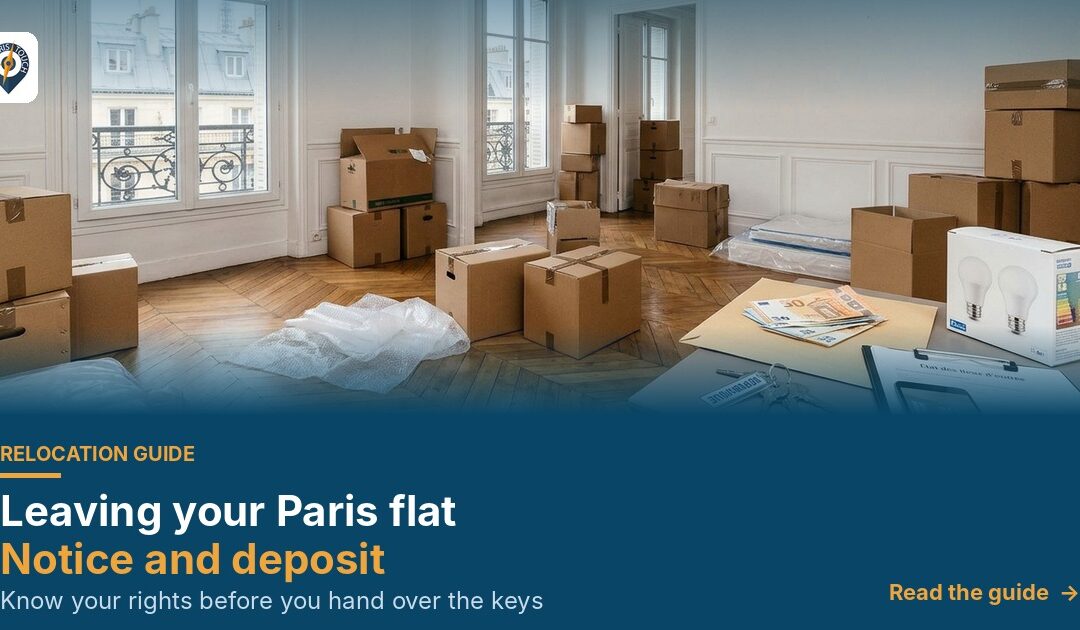
A new job in another country, a lease in Paris. How long are you still going to pay rent? And when will you see your deposit again?
Two questions, and two deadlines that people often mix up. Here is how it works for a main-residence lease under the 1989 law.
Your notice period
Good news if you rent in Paris: it is one month.
- Furnished flat: one month (ANIL).
- Unfurnished flat in a “zone tendue”: one month too, as long as your letter says so (ANIL). A zone tendue is a high-demand area, listed by commune in a decree of 10 May 2013. Paris is one. For a commune outside Paris, check your address on the Service-Public simulator.
How to give notice
Three ways are valid: a registered letter with acknowledgment of receipt, a bailiff’s act (commissaire de justice), or hand delivery with a signed receipt (ANIL).
The notice starts on the day your landlord receives the letter. If a registered letter comes back because nobody collected it, the notice is not valid. Keep your proof.
You keep paying rent and charges until the end of the notice, unless a new tenant takes over with your landlord’s agreement.
The exit inspection
It is done in writing by you and your landlord, and signed by both. It is compared with the move-in inspection, and that comparison is what decides what your landlord can keep from your deposit (ADIL de Paris).
The ADIL advises tenants to hand back a clean flat, to do routine maintenance and small repairs before leaving, to write reservations in the inspection and even to refuse to sign if it is wrong. If you disagree, a bailiff can draw up the inspection, and the cost is shared.
One thing not to do: stop paying the last rents. The ADIL says this is treated as unpaid rent.
Getting your deposit back
- One month after the handover of the keys if the two inspections are identical.
- Two months if they show differences, with the cost of repairs deducted (ANIL).
If your landlord is late, the deposit is increased by 10% of the monthly rent excluding charges for each month started (same source). The ADIL adds that this penalty does not apply if you did not give your new address and your landlord can prove they tried to get it (ADIL de Paris). So give it in writing.
Your landlord can only keep what comes from the comparison of the two inspections, and has to justify it. A quote is enough, an invoice is not required (same ADIL page). In a building with several flats, your landlord may keep up to 20% of the deposit until the building’s annual accounts are approved, and must refund it within a month after the approval (ANIL).
If you disagree, you can go free of charge to a conciliator or to the departmental conciliation commission (same ANIL page).
What I see on the ground
The deposit is a very sensitive subject. There have been quite a few abuses, and there still are. So know your rights, and be very careful at the move-in inspection: everything that follows is compared with it.
Some agencies are known for keeping part of the deposit. I will not name any, but many of my clients came back to me with the same finding, so I stay very careful about which agencies I work with.
Some agencies also bill certain repairs at exorbitant prices. My advice: replace the failing items yourself before you leave, such as the bathtub seal or light bulbs.
Before you leave
- Check your notice period: one month, whether the flat is furnished or unfurnished in a zone tendue.
- Send your notice in a form that proves the date of receipt, and keep the proof.
- For an unfurnished flat, say in your letter that it is in a zone tendue.
- Clean the flat and do the small repairs.
- At the exit inspection, compare with the entry inspection and write your reservations.
- Give your new address in writing, and note the date you hand over the keys: it starts the deposit clock.
Rules summarised from ANIL and ADIL de Paris pages consulted in October 2026. They can change, so check the current text.
Leaving Paris, or moving within the city? Book a free 30-minute call and tell me about your move.