
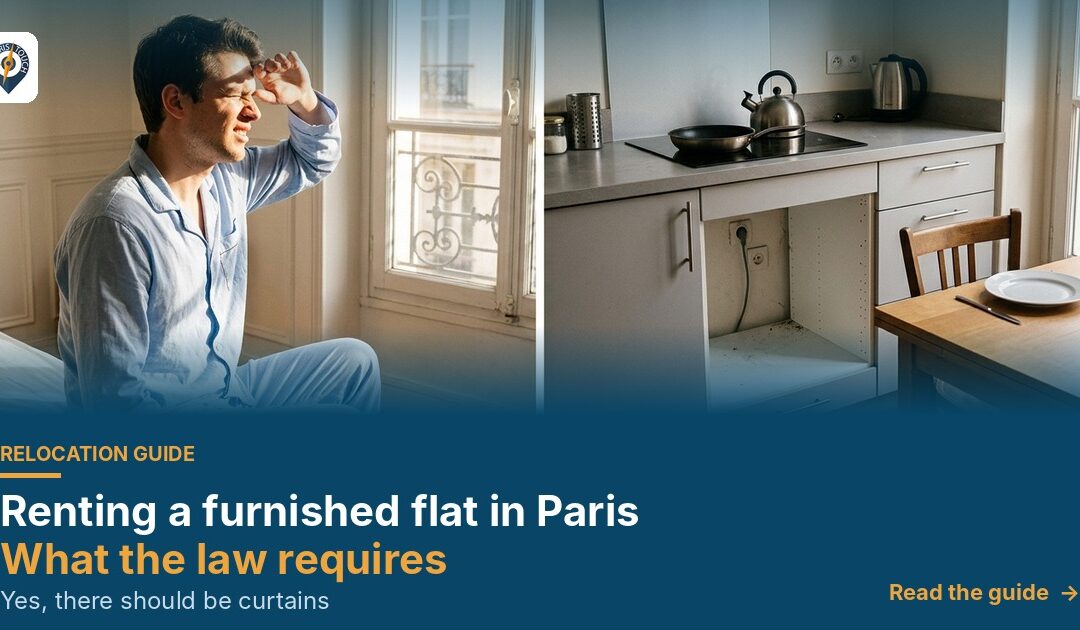
The listing says “furnished”. The light is lovely, the sofa looks nice, the balcony is charming. You visit, you sign.
Did you look for the oven? And the curtains in the bedroom?
Good news: in France, “furnished” is not just a marketing word. For a main residence, the law lists what the flat must contain. Here is that list, what happens when something is missing, and what I see on the ground.
What the law says
A furnished main residence is a decent home with enough furniture, of sufficient quality, to sleep, eat and live there properly (source: ANIL, on the decree of 31 July 2015). This applies to furnished main-residence leases under the 1989 law.
The flat must contain at least:
- bedding, with a duvet or a blanket;
- window coverings in the bedrooms (yes, the curtains);
- hobs;
- an oven or a microwave;
- a fridge and a freezer, or a fridge with a compartment able to reach -6 °C or below;
- the crockery needed for meals, and kitchen utensils;
- a table and chairs;
- storage shelves;
- light fittings;
- cleaning equipment suited to the flat.
And each room needs furniture that fits its purpose. In other words, the bed goes in the bedroom.
If something is missing
According to PAP, a tenant who points out that the flat does not meet the required equipment can ask for the lease to be requalified. The furnished lease then becomes an unfurnished lease of three years, renewable (source: PAP). The same page adds that a sofa bed, a table and a wardrobe do not make a furnished flat.
What I see on the ground
The law says nothing about wear or taste, which makes it a delicate subject with my clients.
With a Civil Code lease, the furniture is generally better and often fairly recent, because owners who choose it feel their offer justifies a higher rent. That is what I see in practice, not a rule. So if you find a stained mattress or worn-out furniture, point it out and try to negotiate. It is worth a try.
Taste is a harder negotiation. Some owners prefer not to make an effort, and the tense Paris market does not help tenants. A few of my clients simply buy a new sofa at their own expense and agree to leave it when they move out.
The opposite happens too: a flat with too much furniture, and antique pieces that belong more in a museum than in daily life. Parisian owners often have no room to store them, and cellars are rare in furnished rentals, so storage can be a real problem. If no compromise is possible, renting a storage space can be the way out.
Furnished or unfurnished: what changes
- Length: one year, renewed automatically. Nine months for a student, with no automatic renewal (ANIL).
- Deposit: up to two months of rent excluding charges, against one month for an unfurnished flat (ADIL de Paris).
- Your notice: one month (ANIL). For an unfurnished flat it is three months in principle, reduced to one in some cases (ADIL de Paris).
The inventory and the move-in inspection
The inventory and the detailed condition of the furniture are attached to the lease and signed by both parties (ANIL). The Paris ADIL advises noting the brand and model of each piece (ADIL de Paris). After you get the keys, you have ten days to complete the move-in inspection.
Before you sign
- Go through the list in the flat, item by item. Yes, open the oven.
- Check that every piece of furniture is in the inventory, with its condition.
- Photograph anything damaged, with the date.
- If something is missing or worn, ask in writing what the owner will replace.
- Keep the lease, the inventory and the inspection together.
Rules summarised from ANIL, ADIL de Paris and PAP pages consulted in October 2026. They can change, so check the current text.
Moving to Paris and looking at furnished flats? Book a free 30-minute call and tell me what you need.